A new approach: ERP for e-Commerce?
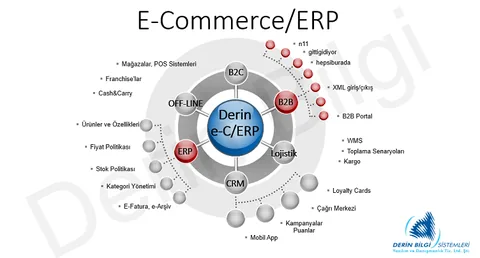
As we combine the points we've reached in different projects, we see that building the entire operation behind e-Commerce on an integrated ERP approach, rather than patchwork, is the right way to go. In fact, this ERP approach should have a name, at least for now, let's settle for a poor abbreviation: e-C/ERP.
Somewhere within this framework omni-channel (which we'll discuss in a separate article), logistics, bir yerinde e-transformation, and marketplaces var. Paylaştığımız görselde olabildiğince mantıklı bir örgü sunmaya çalıştık. Tabi ki daha değişik hiyerarşiler çıkartılabilir, bunu biraz da müşterinin sektörü, satış kanallarının oranı belirleyecektir.
"The important thing is that the entire structure keeps pace with the speed of the online world and the efficiency requirements of intense competition."
A New Sales Channels Table

Off-line: Stores, franchise stores, cash & carry, and similar corporate sales channels are the main environments for offline trade.
On-line : In addition to the above channels, e-Commerce, marketplaces, and B2B channels also form the online world.
When the stock information on marketplaces and B2B portals needs to be well-integrated with the warehouse, when WMS systems need to be managed on a large scale, when a strong connection needs to be established between POS systems in retail and CRM functions, the foundation of the data inevitably becomes ERP. These warehouse and ERP systems must also be suitable for the online world, extremely fast, scalable, and efficient.
Derin E-commerce | Derin Bilgi Sistemleri
"A common mistake is to integrate marketplaces with e-Commerce systems instead of ERP."
The difficulty and necessity of strong integration
In an e-Commerce system disconnected from ERP, visuals are only stored on the site. Prices and categories are also managed on the website due to the inflexibility of ERPs. Customer details, order cancellations, payment controls are also on the site, and if we try to enter the detailed technical specifications of products into classical ERP software and integrate them with the site, we would probably be asked to write a petition first. So, where do our most valuable data remain?
If we have multiple sites, how can we centrally manage different category-stock-price policies? The requirements for e-transformation become complex, and often these cannot even be imagined. Furthermore, e-invoice and e-waybill have now entered our lives.
CRM, omnichannel, customer singularity
Everyone knows that an e-Commerce site is not a CRM system or a logistics system, but how many projects start with these? Updating customer data, maintaining singularity in the CRM database, data quality, and later becoming relevant topics.
"What about the customer's perception of sales channels? The mobile application should cover corporate communication, loyalty card profile information, virtual store, and all shopping history, including online shopping."
Even your own sites and marketplaces create a singularity problem, but if you also have offline sales channels, it is essential to have a comprehensive shopping history, campaign, and points history covering all channels. The publication of responsive sites with hybrid mobile applications does not go beyond displaying the e-Commerce site within a window and moves e-Commerce further away from CRM.
Derin CRM | Derin Bilgi Sistemleri
Price and stock policies
Managing channel-based profitability policies and prices, automatic pricing based on certain margins, categorical and authority-based management of these margins, campaign applications, and their impact on automatic pricing, while sales prices need to be managed together with purchase conditions, making price management a complete ERP process. alış koşullarıyla birlikte yönetilmesi gerektiği için, fiyat yönetimi tam bir ERP süreci Therefore, it is a complete ERP process.
For stock accuracy, there should be rules for reflecting physical stock (product suppliers, warehouses, stores, or virtual stock reserves) for display on sites and marketplaces. This stock must feed all channels instantly when orders are received. The right one should also have a version in its stock.
Logistics
In the transition from business idea to actual operation, e-Commerce turns into a logistics activity. We have implemented various collection scenarios in our projects:
- WMSmodule with warehouse addressing, industrial collection-feeding rules, supporting receiving processes, and warehouse optimization.
- Özellikle taze gıda gibi A special system for small piece products, product-based collection, packaging, labeling,
- and counter handling A special workflow forFast product provision strategies from different points,
- connected purchase-sale orders production, automatic triggering of the supply process, automatic cross-dock directions Many processes, such as integration with cargo companies, require a well-structured data flow.
Can a company with this level of business succeed by starting with e-Commerce site design?
Why is a pallet label used in WMS solutions? | Derin Bilgi Sistemleri
Cargo
Entering product-based volumetric information, cargo contracts, customer and dispatch point-based cargo rules, automatic selection of the most suitable cargo company with contract calculations based on outgoing cargo,integration with cargo companies, require many processes and a well-structured data flow.
Marketplace integrations
Hepsiburada, gittigidiyor, n11 category-product matching, supplier integration, stock updates, invoice address, dispatch address, and membership-current account matching, multi-store management, related data flows, and sales/profitability analyzes all require special solutions. Only because it is commonly constructed in the market, planning this workflow through e-Commerce packages separates processes from basic data sources and does not satisfy fast needs.
Topla.io | Derin Bilgi Sistemleri
Final Words
Can there be a final word on this? There cannot be, but let's conclude like this: The backend of a growing company with a certain level of business, engaged in e-Commerce, or having different sales channels, cannot be sustained with a simple ERP integration or fragmented system integrations.
"The right approach is for companies to structure their operations not according to the architecture of existing products/methods in the market but according to their overall needs."
If such wholeness is achieved in in-house solutions, they are set aside. But the perspective and solutions of Derin Bilgi, which can provide commercial product-service, are indeed like this.