Campaign Types
All common campaign algorithms are supported, except for campaign conditions that are common to all campaign types. Especially in case of conflicts corresponding to a single product on a single line, you can enter the discount precisely into the system with working set, working priority, and number of work values.
With group turnover conditional campaigns, you can use the total amount of a certain group of products as a condition, regardless of the campaign type. Thus, you can implement a discounted product application valid for every 500 TL with a supplier.
The main principle is that the discount is correctly distributed on a single product that will come for return. Then, there is a net unit price ready for a product that will be returned alone. These campaign types are:
Price Discounts
Percentage or amount discounts are applied as net price in some cases, and the difference is calculated as a discount again. In addition, there may be sales quantity limits that will be valid on a single invoice.
Mix-match
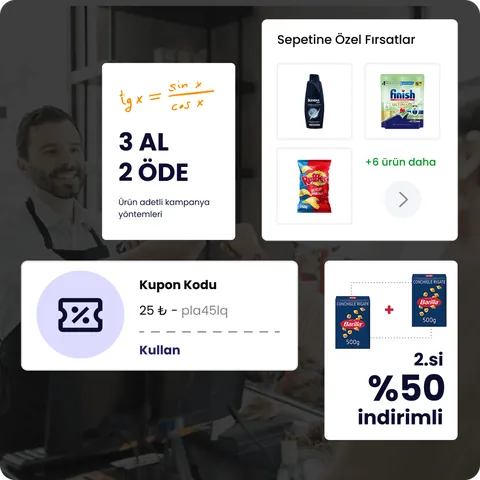
For example, mix-match campaigns that we formulate as "1 B 50% discount for 2 A", automatically come into effect when different or the same products are sold together with a certain quantity condition. The calculated discount value is distributed to these products that provide the condition according to their price ratio.
n Al y Pay (such as 3 al 2 pay)
In this campaign type (let's proceed with the example of 5 al 4 pay), products are sorted from highest to lowest price, and products with quantity are accepted as one on separate lines. Grouping is done in five groups starting from the top of the ranking, and the lowest 5th product is discounted.
Derin KMP | Derin Bilgi Sistemleri